
Why Do My Hands Shake When I Perform — and What Can I Do About It?
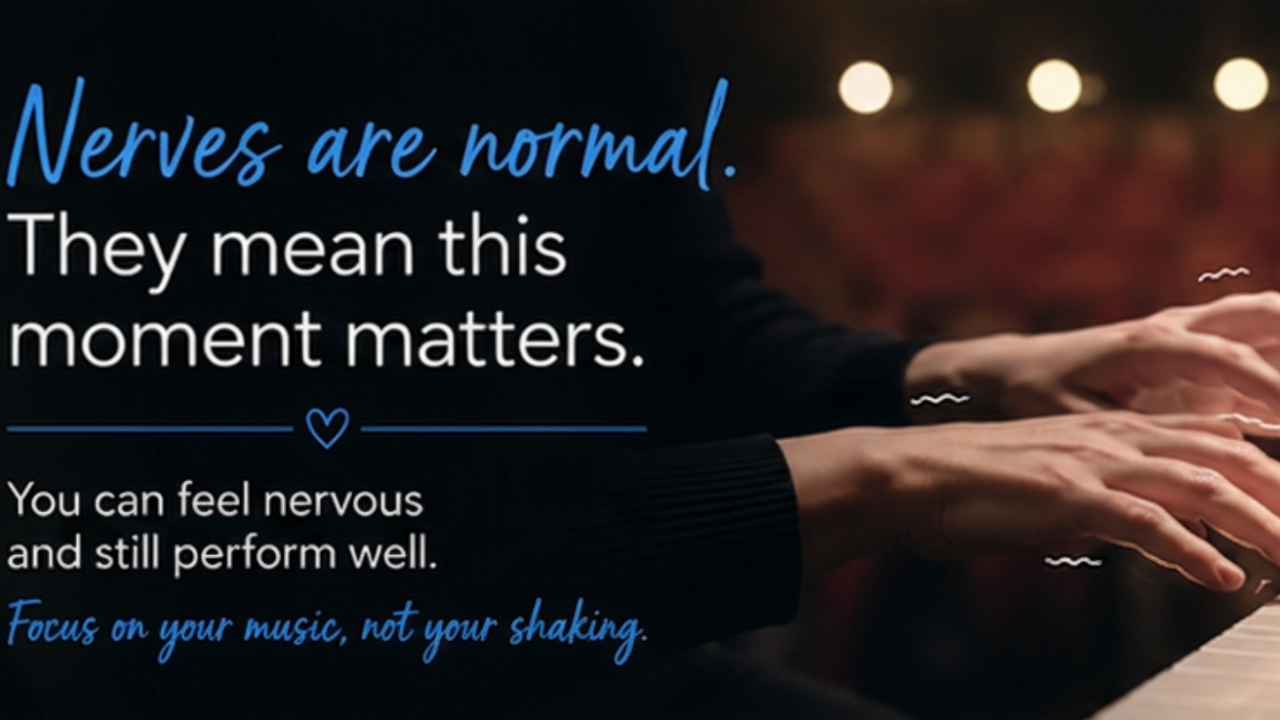
Have you ever stepped onto a stage, walked into a music exam or started a performance only to notice that your hands are suddenly shaking?
Shaky hands are a common physical response to performance nerves and performance anxiety, and they can be especially unsettling for musicians who rely on precise, controlled movements. A racing heart, trembling hands, tense jaw or shoulders, sweaty palms and changes in breathing are all ways the body can respond when a performance feels important.
And once you notice those reactions, it's very easy to start worrying about them.
"Why are my hands shaking?"
"What if I can't control them?"
"What if everyone notices?"
Understanding why these physical reactions happen when you're nervous is an important first step towards changing the way you respond to them. The goal isn't necessarily to make every sign of nerves disappear. It's to develop practical strategies that help you feel more in control, think clearly under pressure and perform with greater confidence.
- Your body is responding to pressure
When we feel nervous or under pressure, the body can automatically switch into a heightened state of alert. A performance, audition or music exam may not actually be dangerous, but your body recognises that something important is about to happen.
This can lead to an increased heart rate, faster breathing, muscle tension, sweaty palms, trembling or shaking.
For musicians, these sensations can feel particularly worrying. You rely on very small, controlled movements to play your instrument, so even a little trembling can suddenly feel enormous.
But experiencing these sensations doesn't mean that something has gone wrong.
Key idea: Shaking doesn't necessarily mean something is wrong. It can simply mean your body has recognised that this moment matters to you.
- Fighting your nerves can make them feel bigger
The moment you notice your hands shaking, another layer of worry can begin:
"Why am I shaking?"
"Everyone will notice."
"I won't be able to play like this."
Suddenly, your attention is no longer on the performance. You're monitoring your hands and trying desperately to make the shaking stop.
The more threatening the sensation feels, the more anxious you may become.
This is where our thinking patterns become important. If we interpret every physical sign of nervousness as evidence that something is going wrong, those sensations can begin to feel even more threatening.
Instead of thinking:
"I have to stop shaking."
Try:
"I'm noticing that my hands are shaking. I'm nervous because this matters to me. I can still perform."
Then bring your attention back to your performance intention. What sound do you want to create? What is the character or style of the music? What story do you want to communicate?
This shifts your attention away from constantly checking what your body is doing and back towards the reason you're there — to perform.
Key idea: You don't have to get rid of every physical sign of nerves before you can perform well.
- What you tell yourself about your nerves matters
Two performers can experience very similar physical sensations but interpret them completely differently.
One might think:
"My hands are shaking. I'm going to mess this up."
Another might think:
"I'm feeling nervous. That's okay. I know what to do."
The sensations may be similar. What's different is the performer's interpretation of those sensations and the thoughts surrounding them.
Learning to notice your thinking patterns is an important part of developing performance confidence.
A racing heart doesn't automatically mean you're going to perform badly.
Shaky hands don't mean you're not prepared.
Feeling nervous doesn't mean you aren't confident.
Notice the story you're telling yourself about what your physical reactions mean. Are your thoughts helping you perform, or are they making the situation feel even more threatening?
Try replacing unhelpful thoughts with something more useful:
"I've prepared for this."
"I can feel nervous and still perform."
"I don't have to be perfect."
"I know what to do next."
The aim isn't to convince yourself that you're not nervous when you clearly are. It's to recognise the nerves without automatically deciding that they mean something is going to go wrong.
Key idea: Feeling nervous and being unable to perform are not the same thing.
- Practise performance, not just your music
Students can spend hours practising their music but very little time actually practising performance.
If most of your practice happens alone in a familiar room, it isn't surprising that performing in front of an audience, examiner or teacher feels different.
This is where Performance Experiments can help.
Try:
- recording a complete performance
- playing for one person
- performing for a small group
- running through your entire program without stopping
- creating a mock exam, audition or concert.
Start with situations that create only a small amount of pressure and gradually make your Performance Experiments more challenging.
Then reflect on what happened.
What did you notice in your body?
What thoughts appeared?
Did your hands shake?
Did you rush?
Where did you hold tension?
What helped you regain your focus?
Performance Experiments aren't about proving that you can perform perfectly. They give you opportunities to notice how you respond to pressure and discover the practical strategies that work for you.
They are also a great opportunity to practise recovering.
If you make a mistake during a Performance Experiment, resist the urge to stop and start again. Keep going. Find your place. Reconnect with your performance intention and continue.
Every time you do this, you're learning something important:
"Something went wrong — and I handled it."
Over time, performing while experiencing some nerves becomes less unfamiliar.
Key idea: Don't just practise your music. Practise performance so you can learn what performing feels like and discover how to manage your own response to pressure.
- Start developing your own pre-performance routine
Students often spend weeks thinking about what they're going to play but very little time thinking about what they'll do in the minutes immediately before they perform.
A pre-performance routine can give you something familiar and constructive to focus on when nerves appear.
There isn't one perfect routine that works for everyone. Part of developing performance confidence is experimenting with different strategies and discovering which ones help you feel more prepared, focused and in control.
Some things you might explore include:
- slowing your breathing and allowing your exhale to be a little longer than your inhale
- noticing and releasing unnecessary tension in your jaw, shoulders, arms, wrists or hands
- gently warming up your body as well as your instrument
- shifting your attention away from physical symptoms and back towards your performance intention
- using a short, helpful phrase to redirect your thinking
- bringing your attention to how you want to begin rather than mentally racing through everything that could go wrong.
You don't need to use all of these.
Experiment.
Notice what changes.
Reflect on what helps.
Then try it again.
Your Performance Experiments are a great place to test different approaches and gradually develop a routine that works for you.
The important thing is not simply having a list of strategies. It's learning which strategies help you, when to use them and how to use them effectively when you're under pressure.
Key idea: You may not be able to choose whether nerves appear, but you can develop and practise how you respond when they do.
When your hands shake, remember:
- Slow your breathing and allow your exhale to be a little longer than your inhale.
- Release unnecessary tension in your jaw, shoulders, arms, wrists and hands.
- Warm up your body as well as your instrument.
- Shift your attention away from the shaking and back to your performance intention — the sound, style or story you want to communicate.
- Notice your thinking patterns and the story you're telling yourself about your nerves.
- Use Performance Experiments to practise performing under mild pressure and discover what works for you.
- Practise recovering and continuing when mistakes happen rather than automatically stopping.
- Develop your own pre-performance routine by experimenting with strategies and discovering what works for you.
So, how do I stop my hands from shaking?
Perhaps this isn't the most useful question.
You may be able to reduce some of the physical reactions you experience when you're nervous, but trying desperately to control or eliminate them can shift even more of your attention towards them.
A more useful question might be:
"What can I do to feel more in control and perform effectively even when I'm nervous?"
That's a very different goal.
Performance confidence doesn't mean reaching a point where you never feel nervous.
Even experienced performers experience nerves.
Confidence develops as you begin to understand your own responses, recognise your thinking patterns, practise performing under pressure and discover the practical strategies that work for you.
Each Performance Experiment gives you another opportunity to ask:
"What happened?"
"How did I respond?"
"What helped?"
"What could I try next time?"
Over time, those experiences can help you approach performance with greater calm, clarity and enjoyment.
Understanding your nerves is the first step. Learning what works for you takes practice.
The strategies in this Confidence Minute are designed to get you started. But building performance confidence happens over time — by recognising your thinking patterns, experimenting with different strategies, reflecting on what happens in performance and developing routines that work for you.
That's why I created The Confidence Factory and its resources: to give young performers practical tools they can use to explore these ideas, put them into practice and discover what helps them perform with greater confidence.
Because knowing what to do is one thing.
Learning how to use those strategies when you're actually under pressure is where the real work begins.
You don't have to wait until the nerves disappear before you can feel confident.
Confidence is something you can develop, practise and strengthen.