
Why Telling Students to "Just Be Confident" Doesn't Work
Every music teacher has seen it.
A student who plays beautifully in the practice room suddenly falls apart in an exam.
Another performs brilliantly at home but freezes on stage.
Some become overwhelmed after one mistake and never recover for the rest of the performance.
It isn't usually a lack of preparation.
It's that performing requires an entirely different set of skills from practising.
Confidence is a Skill
One of the biggest misconceptions surrounding performance is that confidence is simply a personality trait.
Some students appear naturally confident.
Others don't.
But after more than 35 years of teaching and examining thousands of performances, I've found something quite different.
Confident performers are rarely born that way.
They have simply learned ways of thinking and responding that allow them to keep performing, even when they feel nervous.
The encouraging news is that these skills can be taught.
Students Need More Than Technical Feedback
Music teachers spend years learning how to teach posture, tone, rhythm, technique and musicality.
Yet many of us receive very little training in helping students manage the thoughts that appear before and during performance.
Students often say things like:
- "I'm going to mess this up."
- "Everyone is better than me."
- "If I make one mistake, it's over."
These thoughts aren't unusual.
They're incredibly common.
What matters is helping students recognise them and respond differently.
Sometimes the most valuable lesson we teach isn't about the music at all.
It's about helping students continue performing despite feeling uncomfortable.
Small Conversations Make a Big Difference
Building confident performers doesn't necessarily require lengthy lessons about psychology.
Often it starts with asking better questions.
Instead of asking:
"Were you nervous?"
we might ask:
"What helped you keep going after that mistake?"
Instead of:
"Did you practise enough?"
we might ask:
"Which part of your preparation made you feel most ready today?"
Questions like these gradually shift a student's attention away from fear and towards learning, problem-solving and growth.
Over time, those conversations become habits.
And those habits become confidence.
Giving Teachers Practical Tools
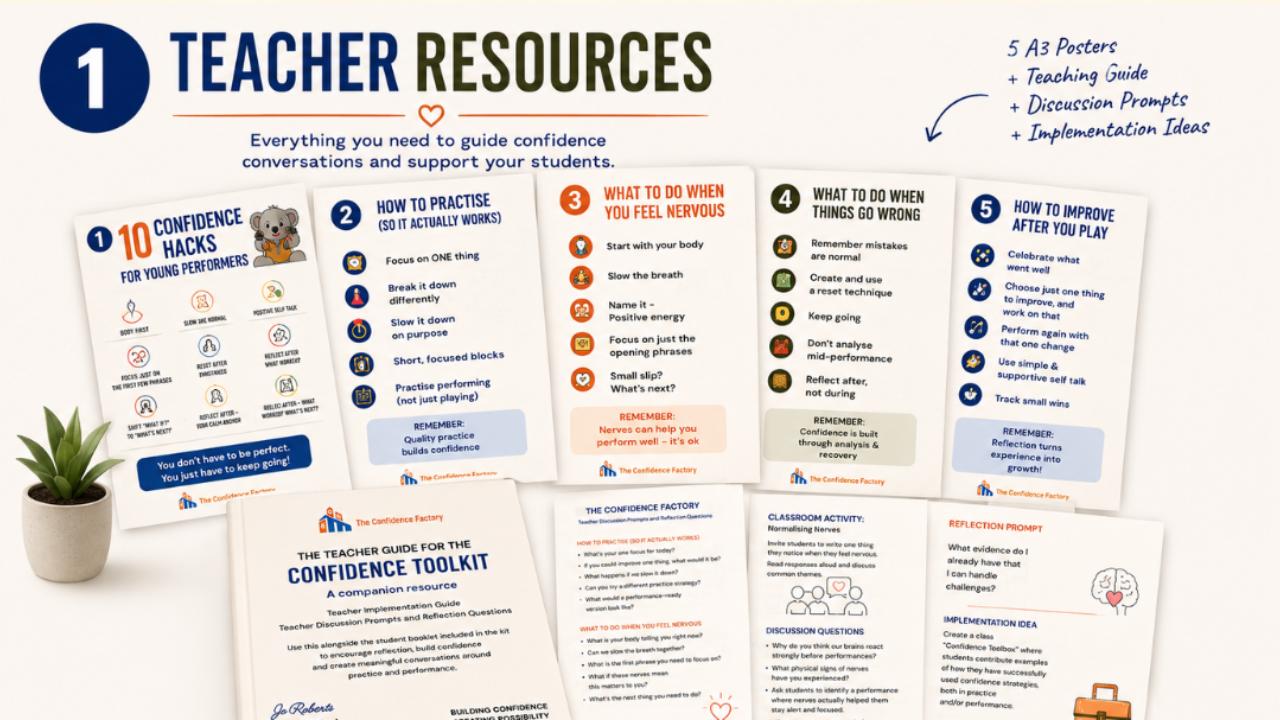
This is exactly why I created the Teacher Confidence Toolkit.
Rather than adding another program to an already busy teaching schedule, the toolkit is designed to fit naturally into lessons.
It includes:
- Large studio posters that keep confidence strategies visible throughout the year.
- Student resources that reinforce those ideas between lessons.
- A practical teacher guide with discussion prompts and classroom implementation ideas.
- Reflection activities that help students build their own confidence strategies over time.
The aim isn't to replace what teachers already do well.
It's to give teachers simple, practical ways to weave confidence-building into everyday music teaching.
The Performers We Remember
Years later, students rarely remember every scale they learned.
They remember how they felt when they walked onto the stage.
As teachers, we have the opportunity to help shape those moments.
When students understand that nerves are normal, mistakes are recoverable, and confidence can be built one performance at a time, they begin to see themselves differently.
And that change often extends well beyond the music studio.
Interested in helping your students build lasting performance confidence?
The Teacher Confidence Toolkit has been designed specifically for music teachers who want practical, ready-to-use resources that support students before, during and after performance.
Explore the toolkit and discover how small changes in your teaching conversations can make a lasting difference.